Amaranthus viridis (Creeping spinach) | Lapo
Amaranthus viridis (Creeping spinach) : medicinal properties in alcoholic extraction
Amaranthus viridis (Creeping spinach) — family Amaranthacées.
This database documents alcoholic (ethanol) extractions of active substances. Our monograph currently lists 18 indications in alcoholic extraction for this species. The monograph draws on 73 scientific references recorded for the species.
Therapeutic indications in alcoholic extraction:
Note: scientific reference excerpts are kept in their original language (most often English), without translation, to respect the source text of publications.
- Cancer : Plant part used: Sheet. Documented pharmacological profile: Doxorubicine-like.
According to House NC (2020): The study evaluated the phenolic contents, antioxidant, anti-inflammatory & anticancer activities of the methanolic extract of aerial parts from Amaranthus dubius (AD), A. The present study highlights the nutraceuticals potential of Amaranthus species in oxidative damages & cancer proliferation. According to JIN YS (2013): Moreover, the ethyl acetate extract not only showed strong antiinflammatory activity on RAW 264.7 cells, but also had greater anticancer activities against HT-29 & HepG2 cancer cells. - Bacterial infection : Plant part used: aerial parts. Documented pharmacological profile: Amoxicilline-like.
According to Sarwar S (2016): Present study was conducted to investigate the antimicrobial potential of Amaranthus viridis ethanolic extracts, against two Gram positive bacterial strains, Staphylococcus aureus & Bacillus subtilis, & four Gram negative bacterial strains via; Proteus vulgaris, Peudomonas picketii, Klebsiella pneumonia & Escherichia coli. Antibacterial assay indicated that AV had inhibitory activity against Ba subtilis, E coli, P vulgaris & P picketii. According to Malik K (2016): Based on results supported by different studies, it was found that the ethanol extract of stem and leaves show greater antimicrobial activity than methanol & chloroform. - Fungal infection : Plant part used: Sheet. Documented pharmacological profile: Ketoconazole-like, Miconazole-like.
According to Cherian P (2016): Antibacterial & antifungal studies were carried out using the precipitated alkaloid, which showed zone of inhibition ranges from 6 to 11mm. Thus, the present study showed that isolated alkaloids can show antimicrobial activity & used for the formulation of drugs or antiseptics. According to Sarwar S (2016): Ethanolic extract was tested against five different strains of fungal species, including;Fusarium solani, Alternaria species, Aspergillus flavus green, Aspergillus nigar & Aspergillus fumigatus.
Further indications (including other extraction modes where applicable), dosages, precautions for use and full scientific references are available in the complete monograph.
Lapotitjéri di la Nati medicinal database
Ethanolic extracts of active substances — monographs, indications, dosages and references for healthcare professionals. Ethnopharmacologist Emmanuel Nossin.
→ Search Amaranthus viridis in the database (subscription required)
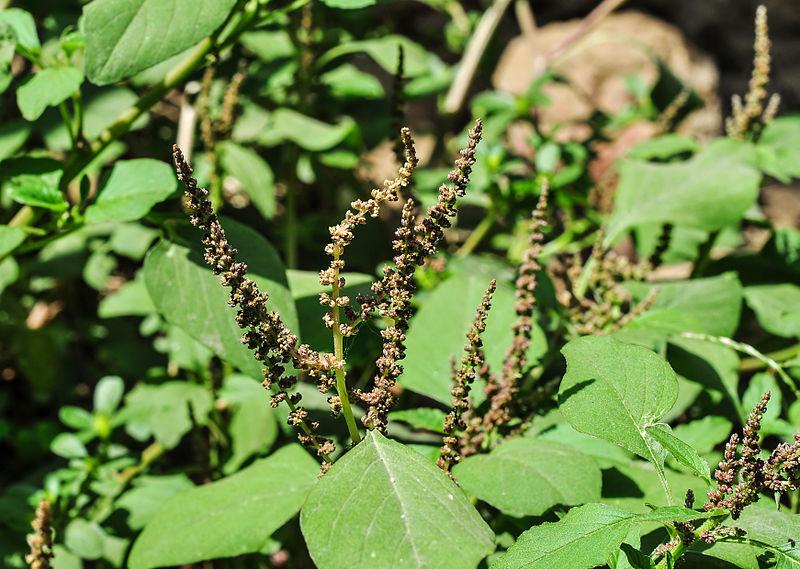
Photo credit : Photo by Joydeep without modification (CC BY 4.0). License : CC BY 4.0.