Plectranthus barbatus (Doliprann’) : medicinal properties | Lapo
Plectranthus barbatus (Doliprann’) : medicinal properties in alcoholic extraction
Plectranthus barbatus (Doliprann’) — family Lamiacées.
This database documents alcoholic (ethanol) extractions of active substances. Our monograph currently lists 8 indications in alcoholic extraction for this species. The monograph draws on 94 scientific references recorded for the species.
Therapeutic indications in alcoholic extraction:
Note: scientific reference excerpts are kept in their original language (most often English), without translation, to respect the source text of publications.
- Bacterial infection : Plant part used: Sheet. Mentioned synergistic association: Streptomycine.
Selon MASTAN A (2020) : Native bacterial endophyte, CFRB1 (Alcaligenes faecalis), significantly modulates primary plant productivity & forskolin content under pot & field conditions. CFRB1 treatment reduced the severity of nematode infection & root rot in CF plants by 81 & 78%, respectively. Selon GELMINI F (2015) : All EOs were tested for their in vitro antimicrobial activity, showing optimal growth-inhibition in antibiogram (∅>35 mm) & MIC tests (32–64 μg/mL) against Candida albicans, while EOs from leaves of both species showed a good activity (25 < ∅ < 34 mm, MIC 64–128 μg/mL) against Escherichia coli. - Mosquito control : Plant part used: Pest control and veterinary products.
Selon Swathi S (2010) : In the present study, ethanolic extracts of leaves of Pongamia pinnata, Coleus forskohlii, & Datura stramonium were evaluated for oviposition deterrent activity against Aedes aegypti & Culex quinquefasciatus. The oviposition deterrent tests of ethanolic extract of P pinnata, C forskohlii, & D stramonium leaves reduced egg laying by 97.62%, 77.3%, 100% against A aegypti & 59.10%, 39.22%, 82% against C quinquefasciatus at higher concentration (0.1%). Selon GOVINDARAJAN M (2016) : In this research, we evaluated the acute toxicity of essential oil from Plectranthus barbatus and its major constituents, against larvae of the malaria vector Anopheles subpictus, the dengue vector Aedes albopictus & the Japanese encephalitis vector Culex tritaeniorhynchus. - Viraemia : Plant part used: Sheet.
Selon ARAUJO SG (2014) : These results encourage additional studies, in order to evaluate the possibilities of using ethanol extracts of Lamiaceae family as natural source for antibacterial activity. Also was evaluated antimicrobial activity of ethanol extracts against 6 bacteria of clinical interest & was tested the interaction of these extracts with a commercial antibiotic Streptomycin. Selon MASTAN A (2020) : CFRB1 treatment reduced the severity of nematode infection & root rot in CF plants by 81 & 78%, respectively.
Further indications (including other extraction modes where applicable), dosages, precautions for use and full scientific references are available in the complete monograph.
Lapotitjéri di la Nati medicinal database
Ethanolic extracts of active substances — monographs, indications, dosages and references for healthcare professionals. Ethnopharmacologist Emmanuel Nossin.
→ Search Plectranthus barbatus in the database (subscription required)
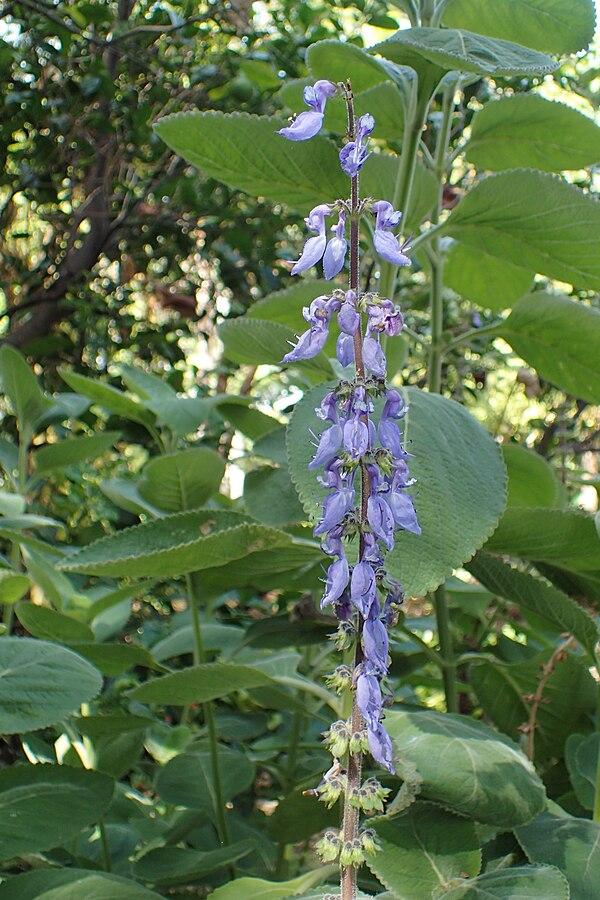
Photo credit : Photo by Krzysztof Ziarnek, Kenraiz without modification (CC BY 4.0). License : CC BY 4.0.