
Ocimum gratissimum (Fonbazen) : vertus médicinales en extraction alcoolique
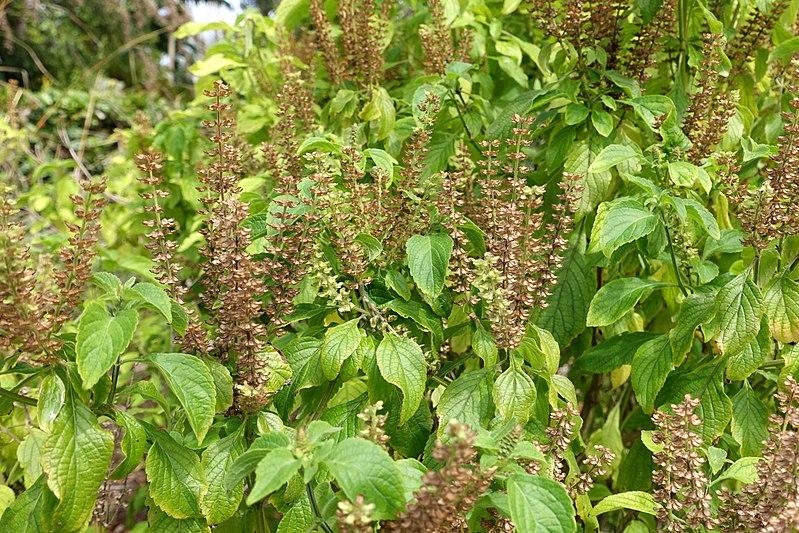
Ocimum gratissimum (Fonbazen) : vertus médicinales en extraction alcoolique
Ocimum gratissimum (Fonbazen) — famille Lamiacées.
Sources externes reconnues associées à cette monographie : TRAMIL.
Cette base documente les extractions alcooliques (éthanol) des substances actives. Notre monographie recense actuellement 21 indications en extraction alcoolique pour cette espèce. La monographie s’appuie sur 77 références scientifiques enregistrées pour l’espèce.
Indications thérapeutiques en extraction alcoolique :
Note : les extraits de références scientifiques sont conservés dans leur langue d’origine (le plus souvent l’anglais), sans traduction, afin de respecter le texte source des publications.
- Champignon des végétaux – carotte : Partie usitée : Usage parasiticide et veterinaire. Profil pharmacologique documenté : Dowicide-like.
Selon Okoi AI (2013) : The microbial pathogens isolated were Rhizopus stolonifer, Fusarium culmorum, Sclerotinia sclerotiorum and Penicillium expansum. The bioactive and antifungal effects of ethanol extracts of Aframomum meleguetta & Ocimum gratissimum were investigated in vitro on causative agents of post-harvest decay of carrots. Selon Okigbo RN (2006) : flavus, Fusarium oxysporum Rhizopus stolonifer, Botryodiplodia theobromae & Penicillium chrysogenum. - Enterococcus faecalis, E coli, P aeruginosa, & S aureus : Partie usitée : Feuille. Profil pharmacologique documenté : Ciprofloxacine-like.
Selon REGASSA HUNDE M (2025) : However, the medicinal plants of Ocimum gratissimum, which are used for two Gram-positive (Staphylococcus aureus & Enterococcus faecalis) & two Gram-negative (Escherichia coli & Pseudomonas aeruginosa) bacteria, were collected from Jimma town of Ethiopia. Antimicrobial resistance (AMR) among bacteria to conventional antimicrobials has become a serious challenge & threat worldwide. Selon NWEZE E (2009) : (Lamiaceae), used in traditional medicine for the treatment of several ailments such as urinary tract, wound, skin and gastrointestinal infections, was evaluated for its antibacterial properties against four clinical bacteria isolates namely: Escherichia coli, Proteus mirabilis, Staphylococcus aureus and Pseudomonas aeruginosa and the antifungal properties using a clinical isolate of Candida albicans. - Infection bacterienne : Partie usitée : Feuille. Profil pharmacologique documenté : Gentamycine-like.
Selon OLUBUKOLA JO (2011) : Methodology: Crude extracts of fresh leaves of Ocimum gratissimum, Psidium guajava, Vernonia amygdalina, Kigelia africana, Azadirachta indica, Pistia stratiotes, Euphorbia hirta, bulb of Allium sativum & Zingiber officinale & Curcuma longa, were evaluated using the agar diffusion assay method & minimal inhibitory concentration (MIC) to determine the antibacterial activities against Vibrio Cholerae, Escherichia Coli & Salmonella Sp. Was not inhibited by ethanolic extracts of Euphorbia hirta and Curcuma longa, both water and ethanolic extracts of others inhibited the growth of Vibrio Cholerae, Escherichia coli and salmonella Sp to varying degree. Selon Regassa Hunde (2024) : The emergence of antimicrobial resistance (AMR) in bacteria is a significant risk & issue associated with conventional antibiotic treatment.
D’autres indications (y compris d’autres modes d’extraction le cas échéant), posologies, précautions d’emploi et le détail des références scientifiques sont disponibles dans la fiche monographique complète.
Base médicinale Lapotitjéri di la Nati
Extraits éthanoliques des substances actives — monographies, indications, posologies et références pour professionnels de santé. Ethnopharmacologue Emmanuel Nossin.
→ Rechercher Ocimum gratissimum dans la base (abonnement requis)
Crédit photo : Photo de Daderot sans modification (CC BY 4.0). Licence : CC BY 4.0.