Plectranthus barbatus (Doliprann’) : vertus médicinales en extraction alcoolique
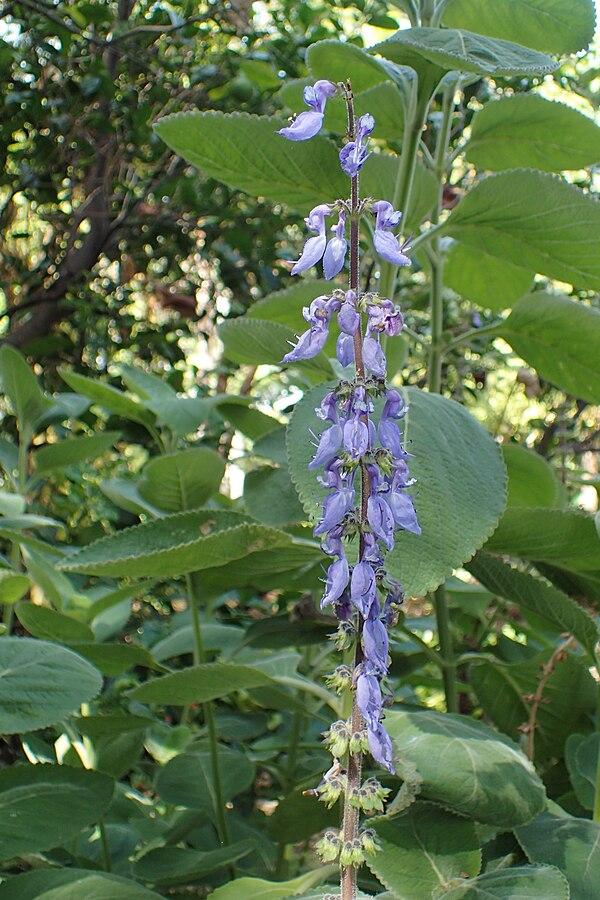
Plectranthus barbatus (Doliprann’) : vertus médicinales en extraction alcoolique
Plectranthus barbatus (Doliprann’) — famille Lamiacées.
Cette base documente les extractions alcooliques (éthanol) des substances actives. Notre monographie recense actuellement 8 indications en extraction alcoolique pour cette espèce. La monographie s’appuie sur 94 références scientifiques enregistrées pour l’espèce.
Indications thérapeutiques en extraction alcoolique :
Note : les extraits de références scientifiques sont conservés dans leur langue d’origine (le plus souvent l’anglais), sans traduction, afin de respecter le texte source des publications.
- Infection bactérienne : Partie usitée : Feuille. Association synergique mentionnée : Streptomycine.
Selon MASTAN A (2020) : Native bacterial endophyte, CFRB1 (Alcaligenes faecalis), significantly modulates primary plant productivity & forskolin content under pot & field conditions. CFRB1 treatment reduced the severity of nematode infection & root rot in CF plants by 81 & 78%, respectively. Selon GELMINI F (2015) : All EOs were tested for their in vitro antimicrobial activity, showing optimal growth-inhibition in antibiogram (∅>35 mm) & MIC tests (32–64 μg/mL) against Candida albicans, while EOs from leaves of both species showed a good activity (25 < ∅ < 34 mm, MIC 64–128 μg/mL) against Escherichia coli. - Démoustication : Partie usitée : Parasiticide et vétérinaire.
Selon Swathi S (2010) : In the present study, ethanolic extracts of leaves of Pongamia pinnata, Coleus forskohlii, & Datura stramonium were evaluated for oviposition deterrent activity against Aedes aegypti & Culex quinquefasciatus. The oviposition deterrent tests of ethanolic extract of P pinnata, C forskohlii, & D stramonium leaves reduced egg laying by 97.62%, 77.3%, 100% against A aegypti & 59.10%, 39.22%, 82% against C quinquefasciatus at higher concentration (0.1%). Selon GOVINDARAJAN M (2016) : In this research, we evaluated the acute toxicity of essential oil from Plectranthus barbatus and its major constituents, against larvae of the malaria vector Anopheles subpictus, the dengue vector Aedes albopictus & the Japanese encephalitis vector Culex tritaeniorhynchus. - Virémie : Partie usitée : Feuille.
Selon ARAUJO SG (2014) : These results encourage additional studies, in order to evaluate the possibilities of using ethanol extracts of Lamiaceae family as natural source for antibacterial activity. Also was evaluated antimicrobial activity of ethanol extracts against 6 bacteria of clinical interest & was tested the interaction of these extracts with a commercial antibiotic Streptomycin. Selon MASTAN A (2020) : CFRB1 treatment reduced the severity of nematode infection & root rot in CF plants by 81 & 78%, respectively.
D’autres indications (y compris d’autres modes d’extraction le cas échéant), posologies, précautions d’emploi et le détail des références scientifiques sont disponibles dans la fiche monographique complète.
Base médicinale Lapotitjéri di la Nati
Extraits éthanoliques des substances actives — monographies, indications, posologies et références pour professionnels de santé. Ethnopharmacologue Emmanuel Nossin.
→ Rechercher Plectranthus barbatus dans la base (abonnement requis)
Crédit photo : Photo de Krzysztof Ziarnek, Kenraiz sans modification (CC BY 4.0). Licence : CC BY 4.0.