Quassia amara (Kina) : vertus médicinales en extraction alcoolique
Quassia amara (Kina) : vertus médicinales en extraction alcoolique
Quassia amara (Kina) — famille Rubiacées.
Sources externes reconnues associées à cette monographie : TRAMIL et Pharmacopée française.
Cette base documente les extractions alcooliques (éthanol) des substances actives. Notre monographie recense actuellement 5 indications en extraction alcoolique pour cette espèce. La monographie s’appuie sur 66 références scientifiques enregistrées pour l’espèce.
Indications thérapeutiques en extraction alcoolique :
Note : les extraits de références scientifiques sont conservés dans leur langue d’origine (le plus souvent l’anglais), sans traduction, afin de respecter le texte source des publications.
- Arthrose, arthrite, rhumatisme, oedème : Partie usitée : Écorce. Profil pharmacologique documenté : Indometacine-like.
Selon TOMA W (2003) : However, when administered intraperitoneally, the HEX extract decreased the paw edema induced by carrageenan, showed antinociceptive effects on the hot-plate test & on acetic acid-induced writhing, & showed sedative effects on pentobarbital-induced sleep. Selon Fiaschetti G (2011) : Many molecules display a wide range of inhibitory effects, including anti-inflammatory, anti-viral, anti-malarial & anti-proliferative effects on various tumor cell types. These molecules gained notoriety after the initial discovery of the anti-leukemic activity of one member, bruceantin, in 1975. - Pédiculose : Partie usitée : Parasiticide et vétérinaire. Profil pharmacologique documenté : Clophenothane-like.
Selon Jensen O (1978) : 454 patients were treated with quassia tincture for head lice. At examination one week later only three patients had hatched lice. Selon Auteur (1991) : Prophylaxis & treatment of pediculosis with Quassia amarga. - Infection fongique : Partie usitée : Écorce.
Selon Diehl C (2016) : Contrarily, QWE had no effect on the growth of Chlamydia trachomatis, but uniquely altered the morphology & quantity of chlamydial inclusions.To the best of our knowledge, this is the first time that QWE is shown to have antiparasitic activity on Trichomonas vaginalis & Demodex spp, an antifungal activity on Malassezia furfur & Candida spp & an antibacterial activity on P. krusei, the latest at a lesser extent, & Malassezia furfur isolated from samples of infected patients, inhibiting the growth of fungi in both a time- & dose-dependent manner.The antibacterial activity of QWE was demonstrated in cultures of P. Selon AJAIYEOBA EO (2003) : AJAIYEOBA EO et al, Antibacterial & antifungal activities of Quassia undulata & Quassia amara extracts in vitro.
D’autres indications (y compris d’autres modes d’extraction le cas échéant), posologies, précautions d’emploi et le détail des références scientifiques sont disponibles dans la fiche monographique complète.
Base médicinale Lapotitjéri di la Nati
Extraits éthanoliques des substances actives — monographies, indications, posologies et références pour professionnels de santé. Ethnopharmacologue Emmanuel Nossin.
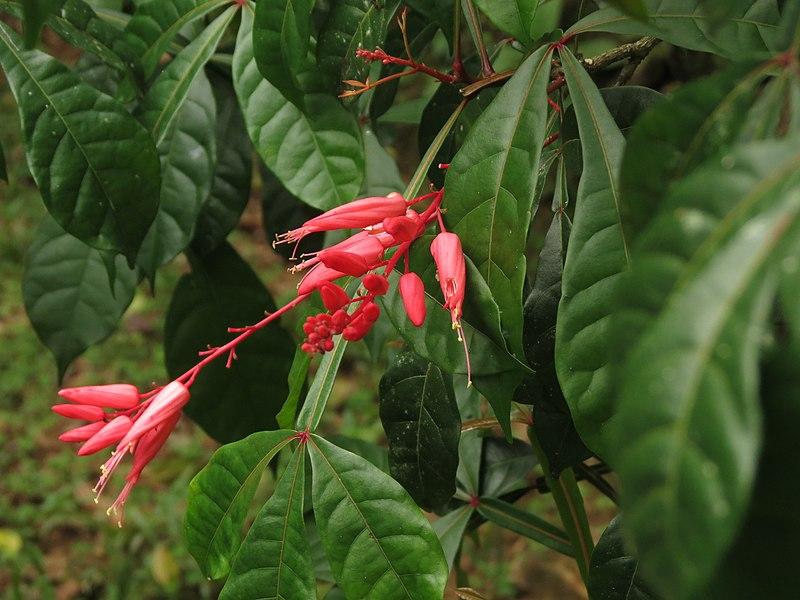
Crédit photo : Photo de iNaturalist.org sans modification (CC BY 4.0). Licence : CC BY 4.0.