Dioscorea bulbifera (Koko-bourik) : vertus médicinales en extraction alcoolique
Dioscorea bulbifera (Koko-bourik) : vertus médicinales en extraction alcoolique
Dioscorea bulbifera (Koko-bourik) — famille Dioscoréacées.
Sources externes reconnues associées à cette monographie : TRAMIL.
Cette base documente les extractions alcooliques (éthanol) des substances actives. Notre monographie recense actuellement 10 indications en extraction alcoolique pour cette espèce. La monographie s’appuie sur 114 références scientifiques enregistrées pour l’espèce.
Indications thérapeutiques en extraction alcoolique :
Note : les extraits de références scientifiques sont conservés dans leur langue d’origine (le plus souvent l’anglais), sans traduction, afin de respecter le texte source des publications.
- Cancer : Partie usitée : Tubercule.
Selon Wang J (2010) : Taken together, our results indicate that the EF contains the main toxic ingredients of DB rhizome, & the mechanism of hepatotoxicity induced by it may be due to liver oxidative stress injury in mice. Hepatic tissues were used to assay for the level of lipid peroxide (LPO), amounts of antioxidants such as glutathione, & activities of antioxidant-related enzymes for liver oxidative-antioxidative status in mice. Selon Li H (2020) : This review illustrates the liver injury induced by DBL including metabolic activation of DSB & EEA, the essential components responsible for DBL-induced hepatotoxicity, along with biochemical mechanisms of their toxic actions. - Arthrose, rhumatisme, arthrite : Partie usitée : Feuille. Profil pharmacologique documenté : Aspirine-like.
Selon Mbiantcha M (2011) : The oral administration of aqueous & methanol extracts caused significant anti-inflammatory activity on paw oedema induced by histamine, serotonin & formalin. The present results show that the bulbils of DB possess potent analgesic & anti-inflammatory activities. Selon Nguelefack TB (2011) : The oral administration of aqueous & methanol extracts caused significant anti-inflammatory activity on paw oedema induced by histamine, serotonin & formalin. - Anxiété, nervosisme : Partie usitée : Tubercule. Profil pharmacologique documenté : Diazépam-like.
Selon Varsha G (2017) : Further, anxiolytic activity of DBE was confirmed by head-dip test in which exploratory activity of mice was increased significantly. Anxiolytic potential of DBE was observed by the results of elevated plus maze test in which DBE significantly increased number of entries & time spent in the open arms.
D’autres indications (y compris d’autres modes d’extraction le cas échéant), posologies, précautions d’emploi et le détail des références scientifiques sont disponibles dans la fiche monographique complète.
Base médicinale Lapotitjéri di la Nati
Extraits éthanoliques des substances actives — monographies, indications, posologies et références pour professionnels de santé. Ethnopharmacologue Emmanuel Nossin.
→ Rechercher Dioscorea bulbifera dans la base (abonnement requis)
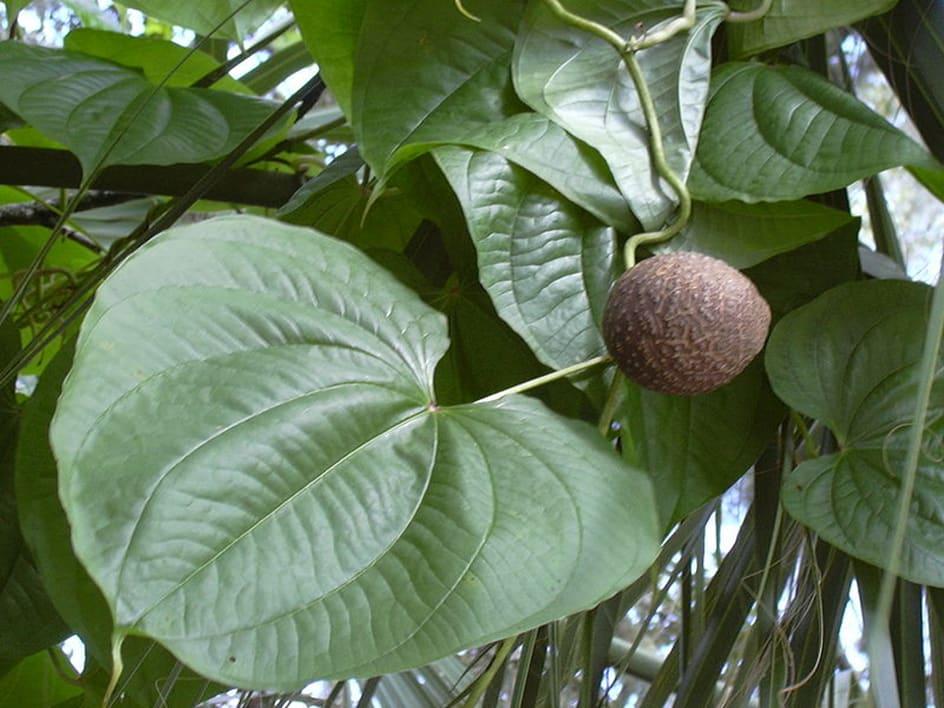
Crédit photo : Photo de Forest & Kim Starr sans modification (CC BY 3.0). Licence : CC BY 3.0.