Allium sativum (Lay) : medicinal properties | Lapo
Allium sativum (Lay) : medicinal properties in alcoholic extraction
Allium sativum (Lay) — family Liliacées.
Recognised external sources linked to this monograph: TRAMIL and French Pharmacopoeia.
This database documents alcoholic (ethanol) extractions of active substances. Our monograph currently lists 25 indications in alcoholic extraction for this species. The monograph draws on 102 scientific references recorded for the species.
Therapeutic indications in alcoholic extraction:
Note: scientific reference excerpts are kept in their original language (most often English), without translation, to respect the source text of publications.
- Bacterial infection : Plant part used: Bulb. Documented pharmacological profile: Gentamycine-like.
According to OLUBUKOLA J O (2011): Methodology : Crude extracts of fresh leaves of Ocimum gratissimum, Psidium guajava, Vernonia amygdalina, Kigelia africana, Azadirachta indica, Pistia stratiotes, Euphorbia hirta, bulb of Allium sativum & Zingiber officinale & Curcuma longa, were evaluated using the agar diffusion assay method and minimal inhibitory concentration (MIC) to determine the antibacterial activities against Vibrio Cholerae, Escherichia Coli & salmonella Sp. Was not inhibited by ethanolic extracts of Euphorbia hirta & Curcuma longa, both water & ethanolic extracts of others inhibited the growth of Vibrio Cholerae, Escherichia coli & salmonella Sp to varying degree. According to Author (2004): Antimicrobial activity of different concentrations (50, 100, 200, 300 & 500 ml/l) of essential oil extracts of three type of onions (green, yellow & red) & garlic against two bacteria, Staphylococcus aureus, Salmonella Enteritidis & three fungi, Aspergillus niger, Penicillium cyclopium & Fusarium oxysporum, was investigated. - Gentamicin-induced nephrotoxicity : Plant part used: Other. Documented pharmacological profile: Albendazole-like.
According to ANUSUYA N (2013): The present study investigated the in vivo antioxidant & Nephroprotective potential of ethanolic extract of garlic (Allium sativum L.) against cisplatin induced nephrotoxicity in Wistar male rats. Methods: Nephrotoxicity was induced by a single intrapéritonéal injection of cisplatin (5 mg/kg b.w.) on the first day of the experiment. According to Rafieian-Kopae M (2013): Gentamicin (GM) nephrotoxicity has been related to oxidative stress. - Atherosclerosis : Plant part used: Bulb. Documented pharmacological profile: Nystatine-like.
According to Mercy KA (2014): The isolates included Trichophyton mentagrophytes, Trichophyton rubrum, Microsporum gypseum, Trichophyton verrucosum & Epidermophyton floccosum. floccosum respectively. According to Khan S (2017): The isolates, which were found to be resistant to antifungal drugs were selected and subjected to antifungal testing against six ethanolic plants, extract namely Azadirachta indica, Allium sativum, Cordia dichotoma Ocimum sanctum, Syzygium cumini & Trigonella foenumgrecum.
Further indications (including other extraction modes where applicable), dosages, precautions for use and full scientific references are available in the complete monograph.
Lapotitjéri di la Nati medicinal database
Ethanolic extracts of active substances — monographs, indications, dosages and references for healthcare professionals. Ethnopharmacologist Emmanuel Nossin.
→ Search Allium sativum in the database (subscription required)
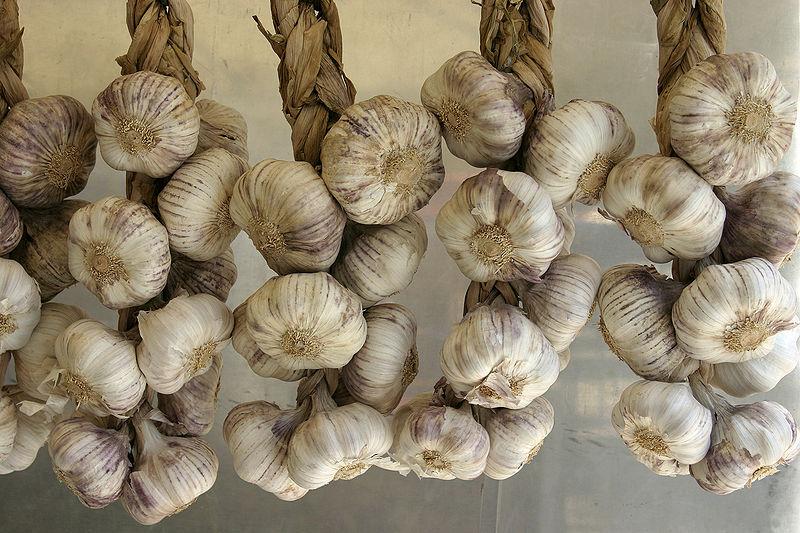
Photo credit : Photo by Nino Babieri without modificatin (CC BY-SA 3.0). License : CC BY-SA 3.0.