Ocimum basilicum (Bazilik) : vertus médicinales en extraction alcoolique
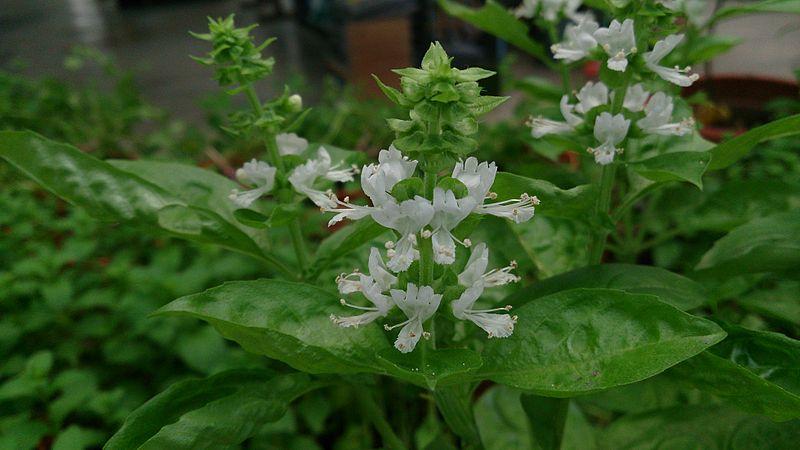
Ocimum basilicum (Bazilik) : vertus médicinales en extraction alcoolique
Ocimum basilicum (Bazilik) — famille Lamiacées.
Sources externes reconnues associées à cette monographie : TRAMIL et Pharmacopée française.
Cette base documente les extractions alcooliques (éthanol) des substances actives. Notre monographie recense actuellement 26 indications en extraction alcoolique pour cette espèce. La monographie s’appuie sur 119 références scientifiques enregistrées pour l’espèce.
Indications thérapeutiques en extraction alcoolique :
Note : les extraits de références scientifiques sont conservés dans leur langue d’origine (le plus souvent l’anglais), sans traduction, afin de respecter le texte source des publications.
- Cancer : Partie usitée : Feuille. Profil pharmacologique documenté : Cisplatine-like.
Selon MANOSROI J (2006) : Anti-proliferative activity of essential oil from 17 Thaï medicinal plants on human mouth epidermal carcinoma (KB) & murine leukemia (P388) cell lines using MTT assay were investigated. In KB cell line, Guava (Psidium guajava L.) leaf oil showed the highest anti-proliferative activity with the IC50 value of 0.0379 mg/ml (4.37 times more potent than vincristine) whereas Sweet Basil (Ocimum basilicum L.) oil gave the highest antiproliferative activity with the IC50 value of 0.0362 mg/ml (12.7 times less potent than 5-FU) in P388 cell line. Selon Alkhateeb MA (2021) : Human MCF7 breast cancer cells were then treated with 3 separate fluctuated concentrations of 0, 50, 150 & 250 µg/mL for 24 and 48 h. - Infection bacterienne et fongique : Partie usitée : Feuille. Profil pharmacologique documenté : Itraconazole-like. Association synergique mentionnée : lagenaria siceraria-hile fixe.
Selon El-Samahy LA (2024) : OB-LNPs & LS-LNPs were tested for their antimicrobial potential against Escherichia coli, Enterococcus faecalis, Klebsiella pneumoniae, Staphylococcus aureus, Salmonella enterica, Trichophyton mentagrophytes, Trichophyton rubrum, & Microsporum canis. rubrum infection in a guinea pig model. Selon -Patil DD (2011) : -Patil DD et al, Antibacterial & Antioxidant study of Ocimum basilicum Labiatae (sweet basil), J of Adv Pharm Educ & Res, 2: 104-112 (2011),. - Démoustication : Partie usitée : Parasiticide & vétérinaire. Profil pharmacologique documenté : Temephos-like.
Selon Hiba El-Amin M (1905) : The present study is designed to investigate the potentialities of Ocimum basilicum leaves powder (LP) & leaf powder –ethanolic extract (LPE) as a larvicide of Anopheles arabiensis 3rd instar larvae (L3) & comparing their results with those of the commonly used (OP) organophosphates larvicide Temephos. A cross sectional study was conducted in Barakat area to collect the Anopheles larvae, identified at the first stage as Anopheles arabiensis & the third stage. Selon Adam AA (2019) : In this work, the EO was assessed for topical repellence effects against malarial vector Anopheles mosquito in cages.
D’autres indications (y compris d’autres modes d’extraction le cas échéant), posologies, précautions d’emploi et le détail des références scientifiques sont disponibles dans la fiche monographique complète.
Base médicinale Lapotitjéri di la Nati
Extraits éthanoliques des substances actives — monographies, indications, posologies et références pour professionnels de santé. Ethnopharmacologue Emmanuel Nossin.
→ Rechercher Ocimum basilicum dans la base (abonnement requis)
Crédit photo : Photo de Mokkie sans modification (CC BY 4.0). Licence : CC BY 4.0.