
Senna alata (Kasialata) : vertus médicinales en extraction alcoolique
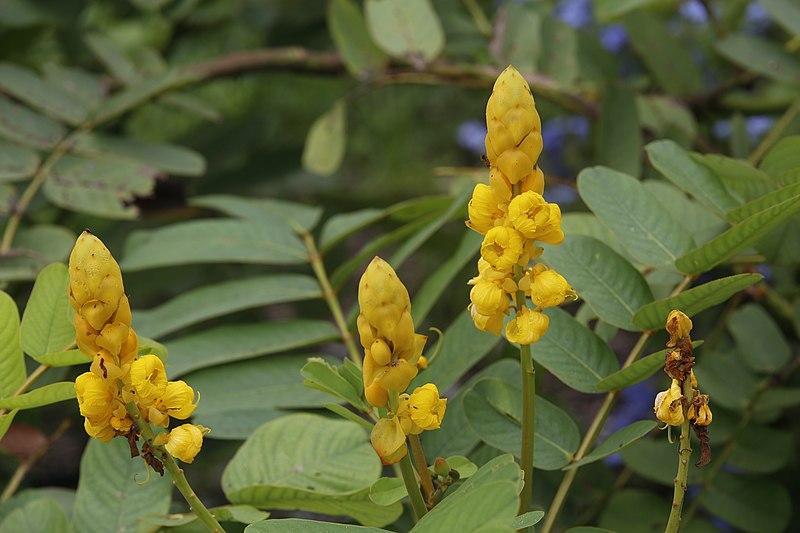
Senna alata (Kasialata) : vertus médicinales en extraction alcoolique
Senna alata (Kasialata) — famille Fabacées.
Sources externes reconnues associées à cette monographie : TRAMIL et Pharmacopée française.
Cette base documente les extractions alcooliques (éthanol) des substances actives. Notre monographie recense actuellement 19 indications en extraction alcoolique pour cette espèce. La monographie s’appuie sur 126 références scientifiques enregistrées pour l’espèce.
Indications thérapeutiques en extraction alcoolique :
Note : les extraits de références scientifiques sont conservés dans leur langue d’origine (le plus souvent l’anglais), sans traduction, afin de respecter le texte source des publications.
- Infection bactérienne : Partie usitée : Feuille.
Selon ODUNBAKU OA (2011) : The antimicrobial activities of ethanolic leaf extract of Senna alata against five bacteria (Staphylococcus Aureus, Staphylococcus albus, Klebsiella pneumonia, Pseudomonas aeruginosa & Proteus mirabilis) & six Fungi (Rhizopus spp, Pénicillium oxalicum, Aspergillus tamari, Aspergillus niger, Fusarium oxysporum & Fusarium vacitilus) were examined using agar diffusion method. mirabilis & all the fungi tested. Selon Adedayo O (2001) : The crude plant extracts, containing steroids, anthraquinone glycosides, volatile oils & tannins, exhibited a high minimum inhibitory con- centration of 500 mg/mL against Staphylococcus aureus, Streptococcus faecalis, Micrococcus luteus, Bacillus subtilis & Pseudomonas putida, but was generally inactive against Escherichia coli, Proteus vulgaris, Pseudomonas aeruginosa, Serratia marcescens, & Pseudomonas fluorescens (above 1000 mg/mL). - Cancer : Partie usitée : Feuille. Profil pharmacologique documenté : Fluoro-Uracile-like.
Selon Olarte E.I (2013) : MTT assays were used to examine the cytotoxic effects of crude extracts on five human cancer cell lines, namely MCF-7, derived from a breast carcinoma, SK-BR-3, another breast carcinoma, T24 a bladder carcinoma, Col 2, a colorectal carcinoma, and A549, a non- small cell lung adenocarcinoma. Considering the cytotoxicity profile & its mode of action, f6l might represent a new promising compound with potential for development as an anticancer drug with low or no toxicity to non-cancer cells used in this study. Selon Auteur (s.d.) : The prevalence rate for colorectal cancer is found to be 9% worldwide. - Candidiase : Partie usitée : Semence. Profil pharmacologique documenté : Tioconazole-like.
Selon Somchit MN (2003) : Crude ethanol & water extract of leaves & barks from Cassia alata were tested in vitro against fungi, (Aspergillus fumigatus & Microsporum canis), yeast (Candida albicans) & bacteria (Staphylococcus aureus & Escherichia coli). albicans showed concentration-dependent susceptibility towards both the ethanol & water extracts from the barks, but resistant towards the extracts of leaves. Selon Alalor CA (2012) : The assessment of antifungal potential of the aqueous & methanol extracts of sun-dried leaves of Cassia alata was investigated by testing the extracts against some fungi (Candida albicans, Trichophyton mentagrophyte, Aspergillus niger & Penicillium) using the Agar cup plate method.
D’autres indications (y compris d’autres modes d’extraction le cas échéant), posologies, précautions d’emploi et le détail des références scientifiques sont disponibles dans la fiche monographique complète.
Base médicinale Lapotitjéri di la Nati
Extraits éthanoliques des substances actives — monographies, indications, posologies et références pour professionnels de santé. Ethnopharmacologue Emmanuel Nossin.